
Performance highlights and selected moments
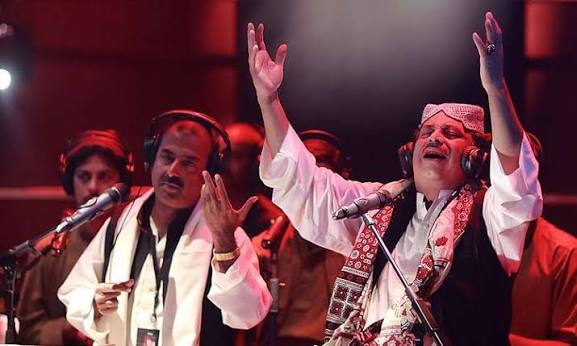
Fareed Ayaz Qawwal is one of Pakistan's most recognized practitioners of traditional Qawwali and Sufi music. A senior exponent of the Qawwal Bachchon Ka Gharana of Delhi, Fareed Ayaz leads the renowned Fareed Ayaz & Abu Muhammad Qawwal and Brothers, an ensemble that has carried the traditional art of Qawwali to audiences across Pakistan and around the world.
With decades of musical training and performance experience, Fareed Ayaz is known for his powerful vocal delivery, command of classical musical structures, intricate rhythmic compositions and deep engagement with Sufi poetry. His performances combine traditional Qawwali with elements of Hindustani classical music, creating extended musical presentations built around poetry, melody, rhythm and spiritual expression.
The ensemble's international reputation has been strengthened through appearances on Coke Studio Pakistan, international festivals, literary events, cultural programs and prestigious concert venues. Their performances of “Kangna”, “Aaj Rang Hai” and “Piya Ghar Aaya” have introduced their traditional Qawwali style to millions of contemporary listeners.
Fareed Ayaz belongs to a longstanding musical lineage associated with the Qawwal Bachchon Ka Gharana, traditionally connected with the musical heritage surrounding Amir Khusrau.
According to interviews and biographies of the ensemble, the family traces its lineage to Mian Saamat Bin Ibrahim, placing Fareed Ayaz within a hereditary Qawwali tradition that has been passed down through generations. Symphony Space describes the group as representing the 26th generation of the original Qawwals associated with this lineage.
Fareed Ayaz received his musical training from his father, Ustad Munshi Raziuddin, a highly respected Qawwal and classical musician. His younger brother Abu Muhammad was also trained by their father, and the brothers eventually developed the ensemble that became known internationally as Fareed Ayaz & Abu Muhammad Qawwal and Brothers.
The influence of Munshi Raziuddin has been central to Fareed Ayaz's musical development.
Munshi Raziuddin was an accomplished exponent of Qawwali as well as classical music. Fareed Ayaz and Abu Muhammad received rigorous training from him, learning not only the vocal techniques required for Qawwali but also the discipline of rhythm, classical musical forms, poetry and traditional performance structure.
In an interview with Dawn, the brothers described their father's insistence on protecting their family's musical heritage during a period when Qawwali faced significant commercial and professional challenges.
This traditional training remains evident in Fareed Ayaz's performances, particularly in the extended development of a composition and his ability to move between poetry, melody and complex rhythmic patterns.
Although Fareed Ayaz is an individual artist, many of his major performances are presented through the Fareed Ayaz & Abu Muhammad Qawwal and Brothers ensemble.
Fareed Ayaz leads the group with his younger brother Abu Muhammad, while other members of the family and trained musicians form the supporting Qawwali party. The ensemble's performances are characterized by lead vocals, supporting vocalists, harmonium, hand percussion and the rhythmic clapping that forms an integral part of traditional Qawwali.
The group also incorporates elements of Hindustani classical music, including forms such as khayal, thumri and tarana, giving their performances considerable musical depth.
One of the most important milestones in Fareed Ayaz's modern career came with Coke Studio Pakistan Season 4 in 2011.
The ensemble performed “Kangna”, a traditional composition presented through an arrangement associated with a complex 10-beat jhaptaal rhythmic structure. According to an interview with Abu Muhammad, the unusual rhythmic cycle presented a significant musical challenge because many Qawwalis traditionally work around six- or eight-beat structures.
“Kangna” introduced Fareed Ayaz and Abu Muhammad to a much larger contemporary audience and became one of their best-known recordings.
The composition was subsequently featured in Mira Nair's 2012 film The Reluctant Fundamentalist. The film used the Qawwali at the beginning of the movie, providing another international platform for Fareed Ayaz's music.
Fareed Ayaz and Abu Muhammad have also performed “Aaj Rang Hai,” the famous Sufi composition associated with Amir Khusrau.
The piece reflects the ensemble's connection with the traditional repertoire of the Qawwal Bachchon Ka Gharana and demonstrates their ability to present historical Sufi poetry through a powerful live Qawwali arrangement.
Their performances of this repertoire are particularly associated with the ensemble's spiritual and devotional musical identity.
Another major national television appearance came with Coke Studio Pakistan Season 11, where Fareed Ayaz, Abu Muhammad Qawwal and Brothers performed “Piya Ghar Aaya.”
The song is based on the poetry of Baba Bulleh Shah, one of the most influential poets of the Punjabi Sufi tradition. Coke Studio's official release presents Fareed Ayaz explaining the devotional meaning of the composition before the ensemble performs it.
The performance combined the traditional Qawwali ensemble with the modern Coke Studio house band, creating a contemporary production while retaining the vocal and poetic character of the original form.
Fareed Ayaz and Abu Muhammad have spent decades performing for audiences outside Pakistan.
Their international concert career has included performances across North America, Europe, the Middle East, Asia and other regions, helping introduce Pakistani Qawwali to audiences unfamiliar with the traditional form.
Symphony Space notes that the ensemble has brought South Asian Qawwali to international audiences for more than four decades and has performed to large audiences around the world.
Their international appearances have included prestigious cultural institutions, literary festivals and music programs.
In 2017, Fareed Ayaz, Abu Muhammad Qawwal and Brothers performed at Asia Society in New York as part of the Lahore Literary Festival.
Asia Society described the performance as a sold-out event, with the Qawwali ensemble bringing the festival to a close.
The performance was significant because it placed a traditional Pakistani Qawwali ensemble within a major international cultural and literary setting.
The ensemble was also the focus of a special BBC Proms concert in 2017.
Their appearance at the BBC Proms represented another important international recognition of Pakistani Qawwali and placed Fareed Ayaz and Abu Muhammad before a major international classical and world-music audience.
In September 2023, Fareed Ayaz, Abu Muhammad Qawwal and Brothers performed at Cairo Opera House as part of a special Qawwali night organized by the Embassy of Pakistan in Cairo.
The event was connected with the 16th International Samaa Festival of Spiritual Music and the 75th anniversary of diplomatic relations between Pakistan and Egypt. The performance was attended by members of the diplomatic corps, Egyptian officials, academics, media representatives and members of the Pakistani community.
The event demonstrated the ensemble's continuing role as international representatives of Pakistani Qawwali and Sufi musical culture.
The group's international concert work has included performances at major cultural institutions.
Their 2017 Asia Society appearance in New York was presented as a performance by the “Masters of Qawwali Sufi music,” and the concert brought the Lahore Literary Festival in New York to a close.
Such appearances have helped position Fareed Ayaz not only as a Pakistani performer but also as an international exponent of South Asian devotional music.
Fareed Ayaz's performance style is deeply rooted in the traditional structure of Qawwali.
A typical performance can develop gradually, beginning with an introduction to the poetry and musical mood before building through repetition, improvisation, rhythmic acceleration and interaction between the lead vocalist, supporting singers and audience.
Dawn's coverage of a 2018 performance described how Fareed Ayaz and Abu Muhammad first establish the musical mood before developing the poetry, with the performance becoming increasingly interactive as it progresses.
This extended format distinguishes a traditional Qawwali mehfil from a conventional short-form concert performance.
Fareed Ayaz's repertoire encompasses poetry from some of the most important traditions of South Asian devotional music.
His performances can include compositions associated with:
Amir Khusrau
Baba Bulleh Shah
Persian Sufi poetry
Punjabi Sufi poetry
Urdu devotional poetry
Classical and semi-classical traditions
Among the best-known pieces performed by the ensemble are Kangna, Aaj Rang Hai, Piya Ghar Aaya, Mann Kunto Maula, Chhap Tilak and other traditional Qawwali compositions.
Fareed Ayaz represents a generation of Qawwals that has maintained the traditional performance system while reaching audiences through modern media.
His appearances on Coke Studio demonstrated that traditional Qawwali could be presented within contemporary music production without removing its essential vocal, rhythmic and poetic identity.
In a Dawn interview, Abu Muhammad discussed how the brothers believed the perception and reach of Qawwali changed significantly after their appearance on Coke Studio.
Their career therefore connects several different musical environments: traditional mehfils, shrines, cultural festivals, television, cinema, literary events and international concert halls.
Fareed Ayaz's recognition is closely connected with both his individual career and the achievements of the Fareed Ayaz & Abu Muhammad Qawwal and Brothers ensemble.
The group has been recognized internationally for its contribution to Qawwali and Sufi music and has performed at major cultural institutions and festivals.
Their appearances at Coke Studio Pakistan, BBC Proms, Asia Society New York, Cairo Opera House and other international venues demonstrate the breadth of their performance career.
The family's musical legacy is also significant. Fareed Ayaz and Abu Muhammad are sons of Munshi Raziuddin, while their musical lineage is traditionally traced through the Qawwal Bachchon Ka Gharana.
Some of the notable documented platforms and performances associated with Fareed Ayaz and the ensemble include:
Kangna – Season 4
Aaj Rang Hai – Season 6
Piya Ghar Aaya – Season 11
BBC Proms – 2017
Asia Society, New York – 2017
Lahore Literary Festival in New York
Cairo Opera House – 2023
International Qawwali and Sufi music festivals across multiple countries
The Reluctant Fundamentalist – 2012, featuring “Kangna”
These appearances demonstrate the transition of Fareed Ayaz's Qawwali from traditional Pakistani mehfils to major international cultural and media platforms.
Fareed Ayaz & Abu Muhammad Qawwal and Brothers are particularly suited to events where live traditional Qawwali and Sufi music are central to the program.
Their performance format can be presented at:
Corporate events
Cultural festivals
Government and institutional events
Weddings and Mehfil-e-Sama
University and college programs
Luxury private events
International Pakistani community events
Sufi and spiritual programs
Literary and cultural festivals
Concerts and large-scale public events
Heritage and cultural celebrations
The ensemble's experience with both intimate mehfils and major international concert venues allows its performance format to be adapted to different cultural and event environments.
Artist Name: Fareed Ayaz Qawwal
Full Performance Name: Fareed Ayaz & Abu Muhammad Qawwal and Brothers
Based In: Karachi, Pakistan
Genre: Qawwali, Sufi Music, Hindustani Classical
Specialization: Traditional Qawwali and Sufi Poetry
Musical Lineage: Qawwal Bachchon Ka Gharana of Delhi
Father & Ustad: Munshi Raziuddin
Key Collaborator: Abu Muhammad Qawwal
Known For: Kangna, Aaj Rang Hai, Piya Ghar Aaya and traditional Qawwali repertoire
Major Platform: Coke Studio Pakistan
International Work: BBC Proms, Asia Society New York, international cultural festivals and concert venues
Performance Type: Traditional Qawwali Ensemble
Fareed Ayaz Qawwal brings generations of Pakistani Qawwali tradition to the contemporary concert stage. Alongside Abu Muhammad Qawwal and Brothers, he continues to perform traditional Qawwali rooted in Sufi poetry, classical musical training and the heritage of the Qawwal Bachchon Ka Gharana.
From Coke Studio Pakistan and The Reluctant Fundamentalist to the BBC Proms, Asia Society New York and international Sufi music festivals, Fareed Ayaz's career reflects the continuing international presence of Pakistani Qawwali.
For concerts, corporate functions, cultural festivals, weddings, government events, private celebrations and international programs, Fareed Ayaz & Abu Muhammad Qawwal and Brothers can be booked through Fankar Online.
Fareed Ayaz Qawwal is doing shows, events and concerts all over the world. It’s very easy to be approached and Booked for Events with Fankar Online, A Registered company with vast experience of artist facilitation & Event Planning.
Fareed Ayaz Qawwal is well known and Highly engaged Artist.
Charges of artist for event, show or concert changes time to time and depends on few factors like how much traveling is require, how they will travel, Stay and Performance Fee.